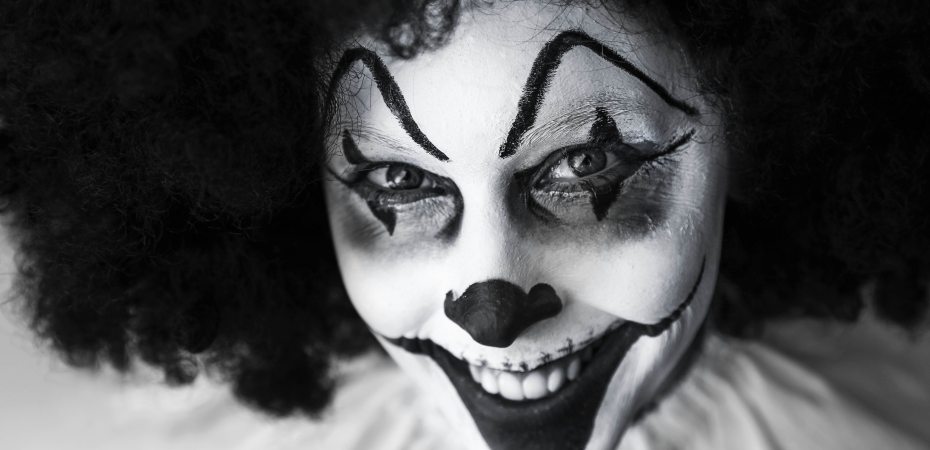
First published through The Paris News on Oct. 12, 2016. The article can be found on their website at http://theparisnews.com/opinion/article_5085f7c0-9094-11e6-bf27-1be862a0e798.html and was backdated.
Who has heard of a sad clown? 
Apparently quite a few real clowns are upset with this creepy clown craze. Some clowns have said it threatens their livelihood and their own safety, plus it hurts their reputation.
Molly Woodall, a longtime friend of mine who clowned as Sparkle said, “It broke my heart to see how something that was supposed to be for fun and happiness has been turned into fear and death.”
Another close friend, Lane Pierce, is in the Air Force, and I wrongfully tease him about his fear by ‘tagging’ him in photos of clowns on social media. It’s still humorous to torment him specifically, but when there’s a “Clown Apocalypse” happening, it might not be my best decision.
“It’s childish to prey on people’s fears.” Pierce said, “It’s not just a harmless prank. People have already gotten hurt and if more continues, it’ll only escalate.”
When the craze began, I sent him a link to a story about a clown sighting, and he didn’t like the idea of being stalked by one.
The clowns involved in this don’t claim to be friendly. Some have even began harassing people with weapons rather than entertaining with balloons.
Not surprisingly, in a 2008 article by BBC, Patricia Doorbar, child psychologist said, “Very few children like clowns. They are unfamiliar and come from a different era. They don’t look funny, they just look odd.”
“Patch Adams,” starring Robin Williams, is a true film based on Dr. Hunter “Patch” Adams and his book, “Gesundheit: Good Health is a Laughing Matter,” which shows how clowns should act towards people — entertain, more than scare.
According to Patch Adams’ website, patchadams.org, Gesundheit Institute, which was founded by Adams and a few of his friends, defines clowning as “spontaneous improvisational play.”
Gesundheit has been traveling and clowning around the world since 1985. In 2006 they began the Global Outreach (GO!CLOWNS) Program, which “cultivates therapeutic alliances while combining healthcare with clowning, collaborative play, music, and art.”
To simplify it, they are entertaining the patients while helping them.
If it were a “Patch Adams” apocalypse, it would be fine. He doesn’t cater to the creepy or scary attributes these clowns create.
In Time Magazine, after Patch Adams heard about Robin Williams’ death, he said, “One important thing I remember about his personality is that he was unassuming — he never acted as if he was powerful or famous. Instead, he was always tender and welcoming, willing to help others with a smile or a joke.”
Robin Williams was based pretty much on real clowns.
Patch Adams once said, “I’m looking for a world where love will no longer be extraordinary.”
 TypicalT